

OOFTAS Global Perspectives Project
Leads: Linda Hobbs & Raphaela Porsch
This project brings together members of the OOFTAS Collective who wish to collaborate on comparing the phenomenon of OOF teaching across countries and jurisdictions.
Out-of-field (OOF) teaching is a global, systemic issue that directly affects the quality, equity, and sustainability of education. By detailing and putting a spotlight on the phenomenon of OOF teaching around the world, this project aims to:
Address a critical but overlooked issue in a global context.
Support teachers, students, and systems through better understanding and action.
Build a foundation for policy reform, professional development, and international collaboration.
By synthesizing country-level data, research, and policy responses, the project:
Illuminates the systemic and contextual factors that give rise to OOF teaching across diverse educational landscapes.
Documents the processes of recognition and inquiry into OOF teaching, including who notices it, how it is monitored, and how it is understood.
Showcases actions taken and mechanisms for change, including professional development, policy reforms, and workforce strategies.
Provides comparative insights that inform future research, policy development, and school-level practices aimed at improving teacher deployment and educational equity.
Countries so far…
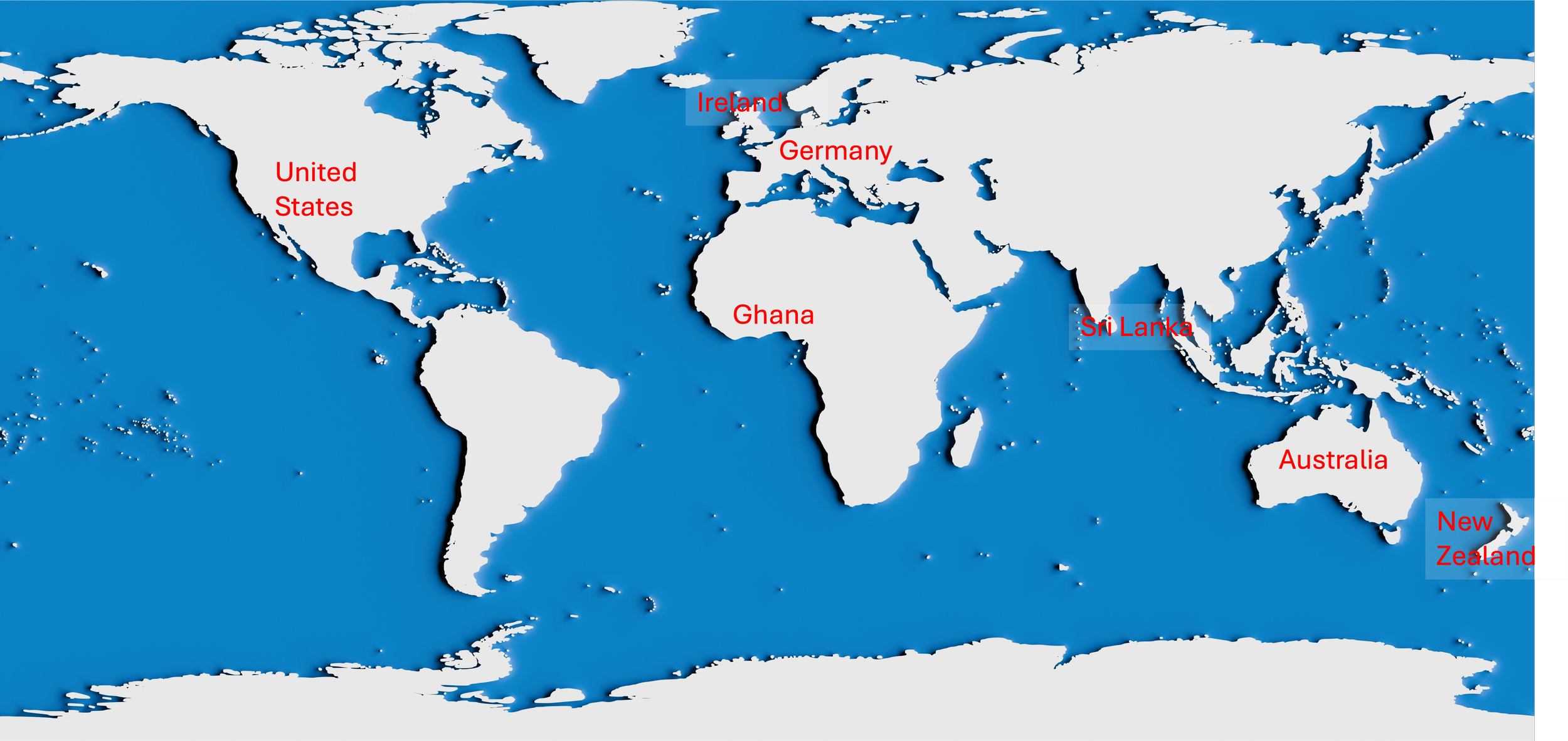
Australia, Germany, Ghana, Ireland, New Zealand, Sri Lanka, United States
Activities so far…
STEP 1. Country descriptions
Several countries have generated country descriptions that detail the following variables:
i. Schooling system and subjects/curriculum
This variable describes how the schooling system is structured—primary, secondary, senior secondary—and the types of subjects and curriculum frameworks offered. It highlights how subjects are defined, allocated, and regulated within the national or regional curriculum.
ii. Initial Teacher Education (ITE) preparation and qualifications (including out-of-field)
This variable outlines how teachers are prepared and qualified as subject teachers, including the structure of ITE programs and any provisions (or lack thereof) for preparing teachers to work outside their field of qualification. It addresses credentialing requirements, specialisations, and pathways into teaching.
iii. Leadership structures and decision-making
This identifies who holds authority over staffing, curriculum allocation, and teacher deployment at school, regional, and national levels. It clarifies how decision-making is distributed and which actors are most influential in shaping responses to out-of-field teaching.
iv. Country/regional governance and system organisation
This variable explains how the education system is organised—centralised, federated, or devolved—and the differences between national, state, or regional authorities. It highlights how governance arrangements influence policy design, implementation, and variability across jurisdictions.
v. Teacher employment conditions
This describes the terms of teacher employment, including contract types, workload, salary structures, job security, and deployment practices. It also covers how these conditions shape staffing flexibility and contribute to or mitigate out-of-field teaching.
vi. Teacher professional learning and development (PLD)
This variable summarises expectations for ongoing professional learning, including required hours, recognised programs, areas of focus, and available support. It also considers how PLD opportunities address or overlook the needs of out-of-field teachers.
vii. Empirical research and data availability on OOFT
This outlines the extent and quality of research evidence and data related to teacher qualification, deployment, workforce patterns, and OOFT. It notes what research questions have been examined and where gaps persist.
viii. System-generated data
This variable describes the types of administrative or policy data collected by the education system (e.g., teacher qualifications, subject assignments, workforce shortages). It considers whether such data can be used to identify and monitor out-of-field teaching.
ix. Other influential organisations (unions, subject associations, etc.)
This identifies key organisations that shape education policy or workforce conditions—such as unions, professional associations, accreditation bodies, and NGOs—and explains their influence on OOFT-related decision-making.
x. Teacher shortages and workforce measures
This variable examines the extent of teacher shortages, the strategies used to address them, and their consequences for out-of-field teaching. It also considers workforce stability trends such as retention and attrition.
xi. Policy changes affecting out-of-field teaching
This highlights recent or significant policy reforms—such as curriculum redesign, staffing policies, qualification frameworks, or workforce incentives—that shape the prevalence and management of out-of-field teaching.
xii. Definition of out-of-field teaching (formal or informal)
This explains how the country or jurisdiction defines out-of-field teaching, including any formal regulatory definitions or informal/local interpretations. It clarifies the criteria used to determine whether a teacher is considered "in-field" or "out-of-field".
STEP 2. Cross country synthesis
Syntheses are underway focused on:
Policy
Measurement and equity
Responses
STEP 3. Identification of research questions
Underway
Expression of Interest to contribute
We are calling for additional countries to get involved. Do you want to get involved? We invite researchers from other countries to be involved. Please submit this form to indicate your interest.